> ## Documentation Index
> Fetch the complete documentation index at: https://reactionrepo.mintlify.site/llms.txt
> Use this file to discover all available pages before exploring further.

# Oxidation with DCM

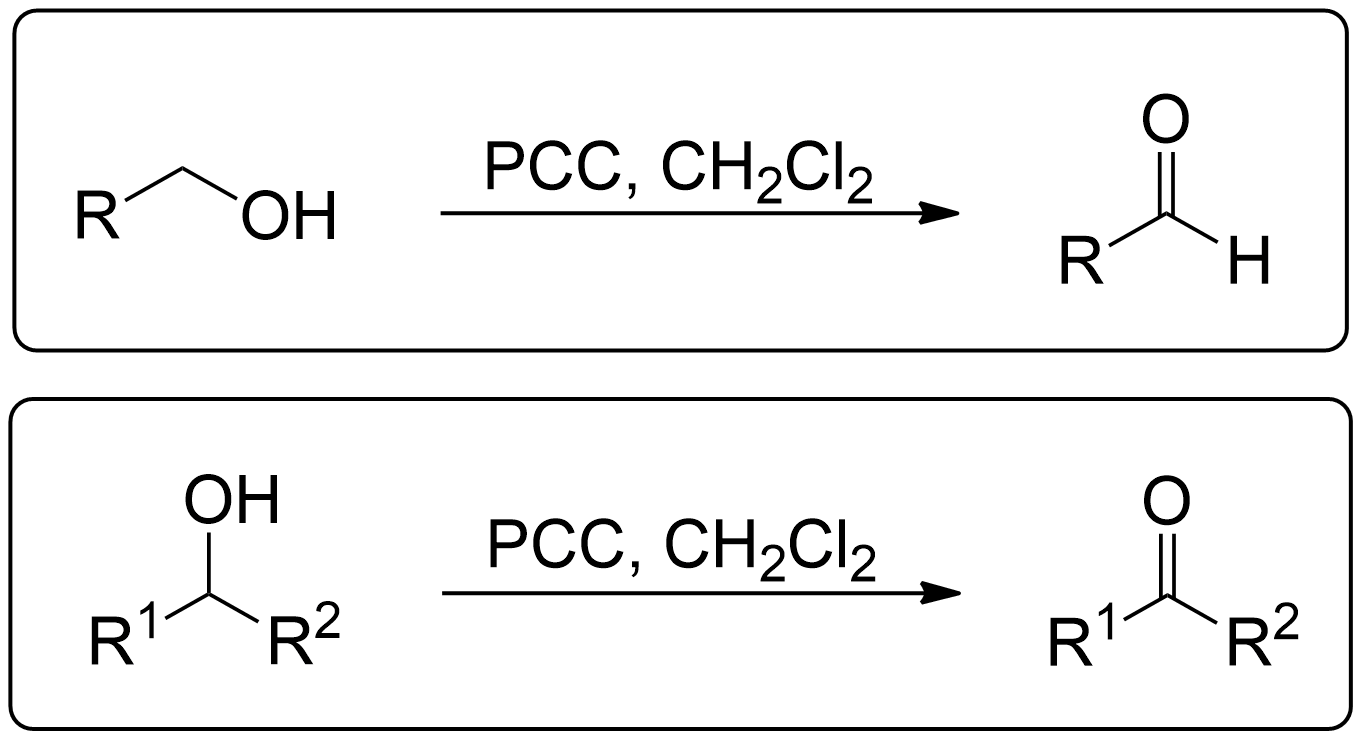
> Mild oxidation method used to oxidize primary alcohols to aldehydes and secondary alcohols to ketones.

<a href="" target="_blank" rel="noopener noreferrer">
  <img noZoom className="block dark:hidden" src="https://mintcdn.com/reactionrepo/GEGTOBBuHI9btv-t/images/corey-suggs-wDCM/PCCReagentOverviewL.png?fit=max&auto=format&n=GEGTOBBuHI9btv-t&q=85&s=789b1e9a448cf7453eff73c19f9ddbea" alt="Hero Light" width="1362" height="740" data-path="images/corey-suggs-wDCM/PCCReagentOverviewL.png" />

  <img noZoom className="hidden dark:block" src="https://mintcdn.com/reactionrepo/GEGTOBBuHI9btv-t/images/corey-suggs-wDCM/PCCReagentOverviewD.png?fit=max&auto=format&n=GEGTOBBuHI9btv-t&q=85&s=279ee4cba045f6c625506876edb45813" alt="Hero Dark" width="1365" height="743" data-path="images/corey-suggs-wDCM/PCCReagentOverviewD.png" />
</a>

PCC is a mild oxidizing agent which can be used to oxidize primary alcohols to aldehydes and secondary alcohols to ketones.<sup>**1**</sup>

## Summary

The reaction entry summary. Find the general scheme and full summarized mechanisms here.

### General Scheme

This section briefly summarizes what can and cannot undergo reactions.

<img className="block dark:hidden" src="https://mintcdn.com/reactionrepo/GEGTOBBuHI9btv-t/images/corey-suggs-wDCM/PCCSumL.png?fit=max&auto=format&n=GEGTOBBuHI9btv-t&q=85&s=632b490125363054fcad65d0a9cf6e67" alt="Hero Light" width="4111" height="369" data-path="images/corey-suggs-wDCM/PCCSumL.png" />

<img className="hidden dark:block" src="https://mintcdn.com/reactionrepo/GEGTOBBuHI9btv-t/images/corey-suggs-wDCM/PCCSumD.png?fit=max&auto=format&n=GEGTOBBuHI9btv-t&q=85&s=1f174ba28b2568cb752ad34940bd5a54" alt="Hero Dark" width="4107" height="367" data-path="images/corey-suggs-wDCM/PCCSumD.png" />

* 1° Alcohols (Primary) get oxidized to **Aldehydes**.
* 2° Alcohols (Secondary) get oxidized to **Ketones**.
* 3° Alcohols (Tertiary) **do not** get oxidized at all.

### General Mechanism

This section briefly summarizes steps to find the product and perform the mechanisms.

**Quick steps to finding the product for any alcohol**

1. Identify the reagents.
2. Assign side chains (non alcohol part).
3. Selectively convert Alcohol to correct product based on alcohol type. Nothing else.
4. Keep the side chains (non alcohol part) the same and piece together the full molecule together again.

<Accordion title="Full Primary Alcohol to Aldehyde Mechanism">
  <img className="block dark:hidden" src="https://mintcdn.com/reactionrepo/GEGTOBBuHI9btv-t/images/corey-suggs-wDCM/PCCPrimL.png?fit=max&auto=format&n=GEGTOBBuHI9btv-t&q=85&s=c2cdfea7d9c9882d18dab0a6c330e56c" alt="Hero Light" title="" width="2936" height="2056" data-path="images/corey-suggs-wDCM/PCCPrimL.png" />

  <img className="hidden dark:block" src="https://mintcdn.com/reactionrepo/GEGTOBBuHI9btv-t/images/corey-suggs-wDCM/PCCPrimD.png?fit=max&auto=format&n=GEGTOBBuHI9btv-t&q=85&s=4e2ba518fa2c20269770847d8b3f1e4b" alt="Hero Dark" title="" width="2937" height="2056" data-path="images/corey-suggs-wDCM/PCCPrimD.png" />
</Accordion>

<Accordion title="Full Secondary Alcohol to Ketone Mechanism">
  <img className="block dark:hidden" src="https://mintcdn.com/reactionrepo/GEGTOBBuHI9btv-t/images/corey-suggs-wDCM/PCCSecL.png?fit=max&auto=format&n=GEGTOBBuHI9btv-t&q=85&s=347680a7cda5b2fa01e5388b07ad858e" alt="Hero Light" title="" width="2937" height="2056" data-path="images/corey-suggs-wDCM/PCCSecL.png" />

  <img className="hidden dark:block" src="https://mintcdn.com/reactionrepo/GEGTOBBuHI9btv-t/images/corey-suggs-wDCM/PCCSecD.png?fit=max&auto=format&n=GEGTOBBuHI9btv-t&q=85&s=70732e84846b7e104ac18b27e195e5cd" alt="Hero Dark" title="" width="2936" height="2057" data-path="images/corey-suggs-wDCM/PCCSecD.png" />
</Accordion>

<Tip>Always remember to repeatedly practice your mechanisms and getting your reagents correct. Take advantage of our materials and/or keep practicing on a whiteboard or paper until you get it right every single time. </Tip>

## References

<div>
  <a href="https://doi.org/10.1016/S0040-4039(00)75204-X" target="_blank" rel="noopener noreferrer">
    <img noZoom class="block dark:hidden" src="https://mintcdn.com/reactionrepo/GEGTOBBuHI9btv-t/images/corey-suggs-wDCM/PCCSource1L.png?fit=max&auto=format&n=GEGTOBBuHI9btv-t&q=85&s=32067a981d9d608152731000352a55ee" alt="Corey-Suggs Light" width="2721" height="363" data-path="images/corey-suggs-wDCM/PCCSource1L.png" />

    <img noZoom class="hidden dark:block" src="https://mintcdn.com/reactionrepo/GEGTOBBuHI9btv-t/images/corey-suggs-wDCM/PCCSource1D.png?fit=max&auto=format&n=GEGTOBBuHI9btv-t&q=85&s=0edca86c79ba6ef7a9f1f7cf9d57cbde" alt="Corey-Suggs Dark" width="2721" height="363" data-path="images/corey-suggs-wDCM/PCCSource1D.png" />
  </a>
</div>

<p>
  1. Corey, E. J.; Suggs, J. W. Pyridinium Chlorochromate. An Efficient Reagent for the Oxidation of Primary and Secondary Alcohols to Aldehydes and Ketones.
     <i>Tetrahedron Lett.</i> <b>1975</b>, <i>16</i>, 2647–2650.
     DOI: <a href="https://doi.org/10.1016/S0040-4039(00)75204-X">10.1016/S0040-4039(00)75204-X</a>
</p>
